
Stop Funding AI Theater.
Start AI That Delivers.
The AI Clarity Method™ helps executives decide what to automate, what to augment, and what not to build — before budget, vendors, or hype get involved.
Most Companies Are Running AI Experiments.
Few Are Running AI Strategies.
of AI projects fail, double the rate of traditional IT projects
- RAND Corporation
of companies abandoned most of their AI initiatives in 2025
- S&P Global Market Intelligence
of executives clearly see where AI revenue will come from
- IBM Executive Survey
Visible Spend. Invisible Value.
Here's what happens when you start with the technology instead of the problem:
Marketing launches a chatbot.
Finance tests a forecasting tool.
Operations tries automation.
IT discovers twelve AI subscriptions nobody approved.
Six months later, the CFO asks: "What did we actually get?"
And the room goes quiet.
You've spent the budget. You've absorbed the disruption. But you can't point to three KPIs that improved. You can't explain which projects are still running. And you definitely can't defend the ROI.
This is AI Theater. It looks like transformation. It costs like transformation. But it doesn't deliver like transformation.
The root cause? You're solving for the tool, not the pain. This isn't a technology problem. It's a decision-making problem.
The Solution: AI Clarity Method™
This is a Decision Framework, NOT a Tool. The AI Clarity Method™ helps enterprise leaders separate signal from noise and invest in AI initiatives that actually move the needle on revenue, cost, and competitive advantage.

Outcome-First
Start with the business result, not the technology
Structured Decision-Making
A clear framework for evaluating every AI opportunity
Measurable ROI
Know the expected return before writing the check
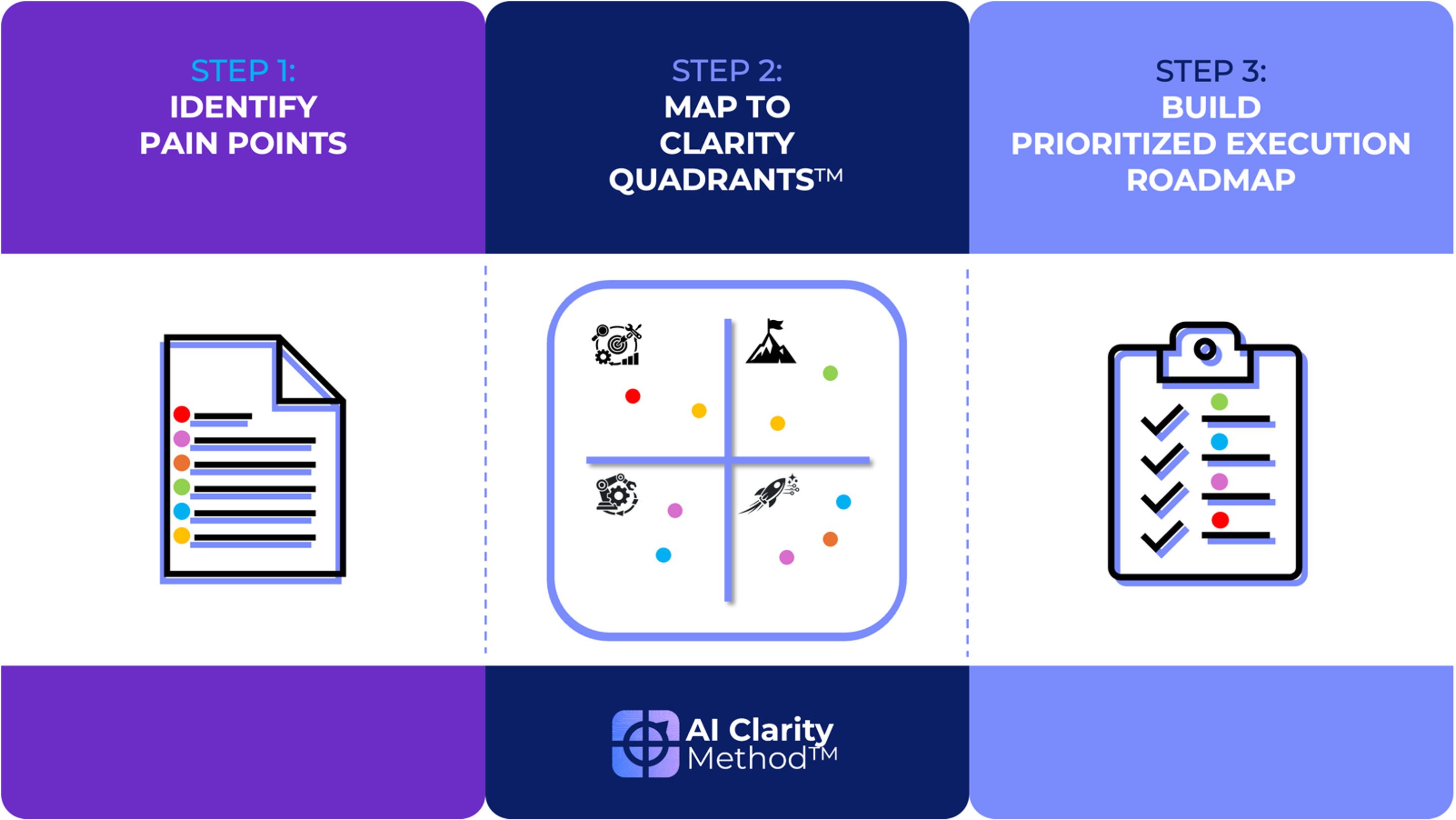
The 3-Step Process
A systematic approach to cut through complexity and align AI investments with business outcomes.
The Pain Point Worksheet
Catalog Every Business Problem
Before we talk about AI, we catalog every business problem in the organization. Not just the loud ones or the politically convenient ones — every pain point costing you time, money, or competitive advantage. We categorize them by strategic vs. tactical, urgency, priority, impact, budget, ownership, and timeline. This worksheet becomes the single source of truth for decision-making.
Key Outcomes
- ✓Ranked, defensible priority list
- ✓Clear ownership & timelines
- ✓Budget aligned to impact
The Clarity Quadrants™ Decision Framework
Map Problems to Optimal Solutions
Now we take each pain point and map it to the optimal solution type. Not every problem needs AI — in fact, most don't. The framework reveals what belongs in Process Improvement, RPA, Tactical AI (quick wins), or Strategic AI (board-level initiatives). This prevents over-engineering and ensures every solution fits the problem.
Key Outcomes
- ✓Right solution for each problem
- ✓Prevents over-engineering
- ✓Clear investment category
Prioritized Roadmap & Execution
From Analysis to Action
Once we've mapped every pain point to a quadrant, we apply a process of ranking and elimination. The output is a visual grid showing exactly where each priority sits, backed by a ranked list with clear ownership, timelines, budgets, and 3–5 success metrics per project. No more pilot purgatory. No more shiny object syndrome.
Key Outcomes
- ✓Clear ownership & accountability
- ✓3–5 success metrics per project
- ✓Defensible roadmap tied to outcomes

The Clarity Quadrants™
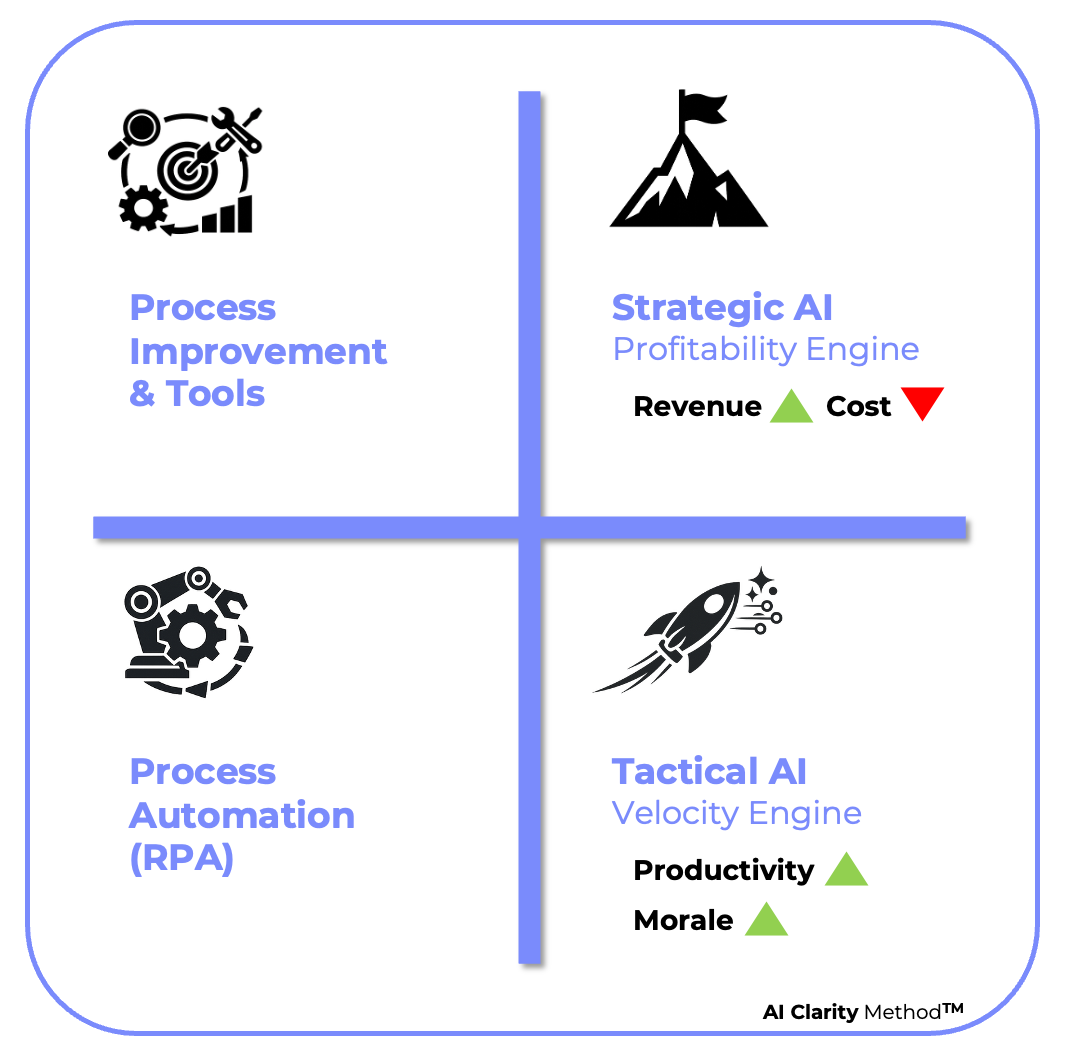
The solution to every Pain Point falls into one of four categories. Each requires different levels of investment, carries different risks, and delivers different returns.

Quadrant 1: Process Improvement & Tools
Fix the Process First
If a problem can be solved by changing a business process or using an existing ERP system, add-on, or app, it belongs here. This prevents over-engineering. You don't need AI to fix a broken approval workflow — you need better process design.
When to Use
Process or ERP can solve it
Expected ROI
Avoids over-engineering costs

Quadrant 2: Process Automation (RPA)
Rules-Based Automation
If a problem requires deterministic, rules-based automation — like data entry, invoice processing, or report generation — it belongs here. Tools like Power Automate or UiPath are perfect. No Generative AI required. High accuracy, low cost, fast deployment.
When to Use
Deterministic, rules-based tasks
Expected ROI
High accuracy, low cost
Quadrant 3: Tactical AI
The Velocity Engine
Low-complexity, departmental "quick wins" solved in days or weeks using Agentic AI tools, internal knowledge bases, or productivity copilots. Funded through OPEX. Success is defined by Operational Velocity: time saved, morale improved, obstacles removed, efficiency increased.
When to Use
Departmental quick wins
Expected ROI
Operational velocity gains

Quadrant 4: Strategic AI
The Profitability Engine
CAPEX investment for BHAGs (Big Hairy Audacious Goals) that impact competitive advantage. Success is defined by Hard Financial Profitability: Cost Reduction (baseline), Revenue Generation (sweetener), or the "Unicorn" Victory (both simultaneously). Gains must be ascribable to specific departments.
When to Use
Board/C-Suite approval required
Expected ROI
Cost reduction + revenue growth
The insight: Strategic AI (Quadrant 4) requires rigorous TCO/ROI analysis, change management, partner selection, and 3–5 measurable success criteria. You should only have 1–3 Strategic AI initiatives running at a time. Meanwhile, Tactical AI (Quadrant 3) needs IT visibility via an AI Tool Registry, but IT should create a "Safe Harbor" with an AI Use Handbook, enterprise licensing, training, and a culture where "good failures" are seen as steps toward success.
Who This Is For
Built for enterprise leaders who need to separate AI signal from noise, fast.
CEO
The Accountability Owner
Your Challenge
The board is asking for "an AI strategy." Competitors are making AI announcements. Consultants are pitching pilots. You need a plan that ties to actual business outcomes.
What You Get
A framework to confidently present to the board that shows how AI investments map to revenue, cost, and competitive positioning before the first dollar is spent.
CFO
The ROI Gatekeeper
Your Challenge
Every department wants AI budget. Sales wants AI for leads. Operations wants automation. IT wants everything. You need a way to separate real ROI from vendor promises.
What You Get
A clear-eyed analysis that quantifies expected returns, flags hidden costs, and prioritizes investments by financial impact. No more "trust us, it'll pay off."
CIO/CTO
The Implementation Leader
Your Challenge
You're drowning in vendor pitches, PoC requests, and "urgent" AI projects. Teams want to experiment, but you need guardrails. Shadow IT is spinning up GenAI tools without oversight.
What You Get
A decision framework that aligns technical feasibility with business value, helping you prioritize, de-risk, and deliver AI projects that actually ship and scale.
This Is Not For Everyone — and That's Intentional.
For:
- C-Suite Executives
- PE-backed operators
- Enterprise leaders under board pressure to "do something with AI"
Not For:
- Teams looking for shiny demos
- "Let's try Copilot everywhere" strategies
- AI experimentation without ownership
If You're Going to Invest in AI,
You Owe Yourself Clarity First.
Getting AI strategy wrong doesn't just waste budget. It compounds.
Without Clarity
- ✗Millions spent on pilots that never scale
- ✗Teams demoralized by failed "innovation theater"
- ✗Competitors pull ahead with faster, smarter AI execution
- ✗Board loses confidence in leadership's tech vision
- ✗Budget cuts after "AI didn't deliver"
With Clarity
- ✓Every AI investment tied to measurable business outcomes
- ✓Teams aligned on priorities and success criteria
- ✓Fast execution on high-ROI opportunities
- ✓Board sees AI as strategic advantage, not cost center
- ✓Continuous improvement as wins compound
The question isn't "Should we do AI?"
It's "Which AI investments will move the needle?"
Built by Someone Who's Seen AI Projects Fail and Succeed
As a consultant, I have spent nearly 20 years helping leaders and teams decide what not to build as often as what to build.
I've seen organizations spend significant amounts of money on initiatives that were never tied to a clear business signal in the first place. This risk is amplified in the AI era, where the pressure to "do something with AI" pushes teams to move fast without defining the problem, success metrics, or financial impact.
I created the AI Clarity Method to stop that cycle.

Key Credentials
8 Years in C-Suite
Partner and COO at DSWi, an award-winning Microsoft Business Applications Partner
Trusted Thought Leader
Serves on Professional Association Boards and Global Industry Conference Programming Committees
15 Years of Public Speaking
Top-rated speaker who has delivered presentations and workshops at over 50 worldwide conferences on Business Applications & AI strategy
8-Time Microsoft MVP
Copilot Studio (Agentic AI) and Dynamics 365 Business Central (ERP)
AI Educator
Founder of OnlyCopilotFans.com and YouTube channel dedicated to AI learning content
AJ Ansari
AJ is a business leader and a decorated veteran of the tech community, bringing nearly two decades of experience as a trusted advisor to businesses seeking to maximize value from their AI and ERP investments.
He is an 8-time Microsoft MVP, awarded for his technical leadership, advocacy and engagement in the ERP and Agentic AI space. AJ is passionate about sharing his knowledge with the community and has spoken at over 50 global technology conferences and industry events. Through his talks, masterclasses, workshops, bootcamps and online contributions, AJ has built a reputation for translating complex technical concepts into practical solutions.
Recognition & Awards
What Leaders Say About AJ
The creator of the AI Clarity Method has been a trusted advisor to business leaders for nearly two decades.
“It is great that (AJ) can explain concepts in ways people from different technical backgrounds can understand. (AJ) gave us many examples and detailed explanations of concepts and reminded us to ask questions throughout…”
Tola Coates
Director, Camelot 3PL Software
Choose Your Path to Clarity
Every engagement delivers the same proven framework. The difference is depth, stakeholder involvement, and execution support.
Catalyst
For growth-stage companies ready to stop experimenting and start executing.
- Pain Point Discovery Workshop (2 hours)
- Clarity Quadrant Mapping Session (2 hours)
- Prioritized AI Roadmap Document
- Executive Summary Presentation (PDF)
- 30-day follow-up call
- Up to 3 stakeholders included
Best For:
Companies with $10M–$50M revenue navigating their first AI investment decisions.
Ascent
For organizations where AI decisions require cross-functional alignment and board-level defensibility.
- Everything in Catalyst, plus:
- Extended Pain Point Workshop (half-day)
- Cross-functional stakeholder interviews (up to 6)
- Detailed Clarity Quadrant Analysis with ROI projections
- Board-Ready Executive Briefing Deck
- Vendor Evaluation Criteria (if applicable)
- 60-day follow-up call
- Up to 8 stakeholders included
Best For:
Companies with $50M+ revenue, PE-backed operators, or leadership teams under board pressure to present an AI strategy.
Advisory
For organizations that need embedded guidance through execution.
- Everything in Ascent, plus:
- Multi-day on-site engagement
- Unlimited stakeholder interviews
- Quarterly roadmap reviews (6–12 months)
- Vendor selection support
- Implementation checkpoint calls
- Direct access to AJ for strategic questions
- Custom scope based on organizational complexity
Best For:
Large enterprises, multi-division organizations, or companies undergoing major transformation initiatives.
Optional Add-Ons
Quarterly Strategy Review
$3,000/quarter
Board Presentation Support
$2,000
Limited availability — AJ personally leads every engagement.
Frequently Asked Questions
Everything you need to know about the AI Clarity Method and how it can help your organization.
The AI Clarity Method is a strategic framework that helps business leaders cut through AI hype and make confident, ROI-driven decisions. Instead of chasing every new AI trend, it provides a structured approach to identify which AI investments will actually move the needle for your organization—and which ones are just "AI Theater."
The four quadrants categorize AI opportunities based on complexity and business impact: Process Improvement (low complexity, operational gains), RPA (automation of repetitive tasks), Tactical AI (targeted AI solutions for specific problems), and Strategic AI (transformational initiatives). This helps you prioritize investments and allocate resources where they'll deliver the greatest return.
Catalyst is ideal if you need a focused one day engagement starting with a 2-hour strategy session to gain clarity on your AI roadmap. Ascent provides deeper, hands-on guidance over a two day engagement for organizations ready to build and execute an AI strategy. Advisory offers everything in Ascent, plus ongoing strategic partnership for enterprises requiring continuous AI leadership support. Not sure? Book a 30-minute AI Clarity Call to discuss your needs.
This framework is built for Accountability Owners—CEOs, CFOs, CIOs, and senior leaders who are responsible for AI investments and their outcomes. If you're being asked to approve AI budgets, justify AI spend to stakeholders, or lead digital transformation, this method gives you the clarity to make those decisions with confidence.
Most clients gain immediate clarity once they complete the workshopping process of mapping their pain points to the Clarity Quadrants and building their Prioritized Execution Roadmap. From there, success depends on following through on your roadmap—implementing solutions in the right order, measuring outcomes, and iterating based on results. The framework gives you a clear path; executing it delivers the ROI.
Traditional consulting often sells you on implementation before you've defined the problem. The AI Clarity Method flips that—we don't start by asking "How can we use AI in our processes?" We start by asking "What are the points of friction, the Pain Points, that we need to solve?" and then set about finding the best solution for each pain point. You'll walk away knowing exactly where AI fits (and where it doesn't) before spending a dollar on development. It's strategy first, implementation second.
Get in Touch
Have questions about the AI Clarity Method? Want to discuss how it applies to your organization? Reach out.
Ready to Connect?
Tell us about your AI strategy challenges and we'll be in touch.
Contact Information
What to Expect
- ✓Response within 2 business days
- ✓Initial consultation to understand your needs
- ✓Customized guidance on applying the framework
- ✓Options for deeper engagement if needed